Eduqas · GCSE · English Language
Component 1: 20th Century Literature Reading Study and Creative Prose Writing (40%, 1 hour 45 minutes)
Component 1 tests your ability to read and analyse unseen 20th-century fiction, focusing on how writers use language and structure to create effects. It also assesses your creative writing skills, requiring you to produce an engaging, well-structured, and technically accurate narrative or descriptive piece.
- 6 min read
- 3 worked examples
- 5 practice questions
- 8 key terms
Study Notes
Overview
GCSE English Language Component 1 (20th Century Literature Reading Study and Creative Prose Writing) is a 1 hour 45-minute examination that makes up 40% of your total GCSE grade. The paper is split into two distinct sections: Section A focuses on reading and analysing an unseen extract from a 20th-century prose fiction text, while Section B requires you to produce your own piece of creative prose writing. Success in this component requires a deep understanding of how writers craft their work to influence readers, and the ability to apply those same techniques in your own writing.
The Podcast
Listen to our comprehensive revision podcast for a deep dive into the skills you need for this exam:
Reading Skills (Section A)
In Section A, you are assessed on Assessment Objectives 1, 2, and 4. The examiner is looking for your ability to locate information, analyse the writer's methods, and evaluate the text critically.
Identifying Information & Ideas (AO1)
The first questions on the paper will typically ask you to list or identify specific details from the text. This tests your ability to locate explicit information (what is clearly stated) and implicit information (what is suggested or implied). You must ensure you only draw evidence from the specific lines mentioned in the question.
Analysing Language (AO2)
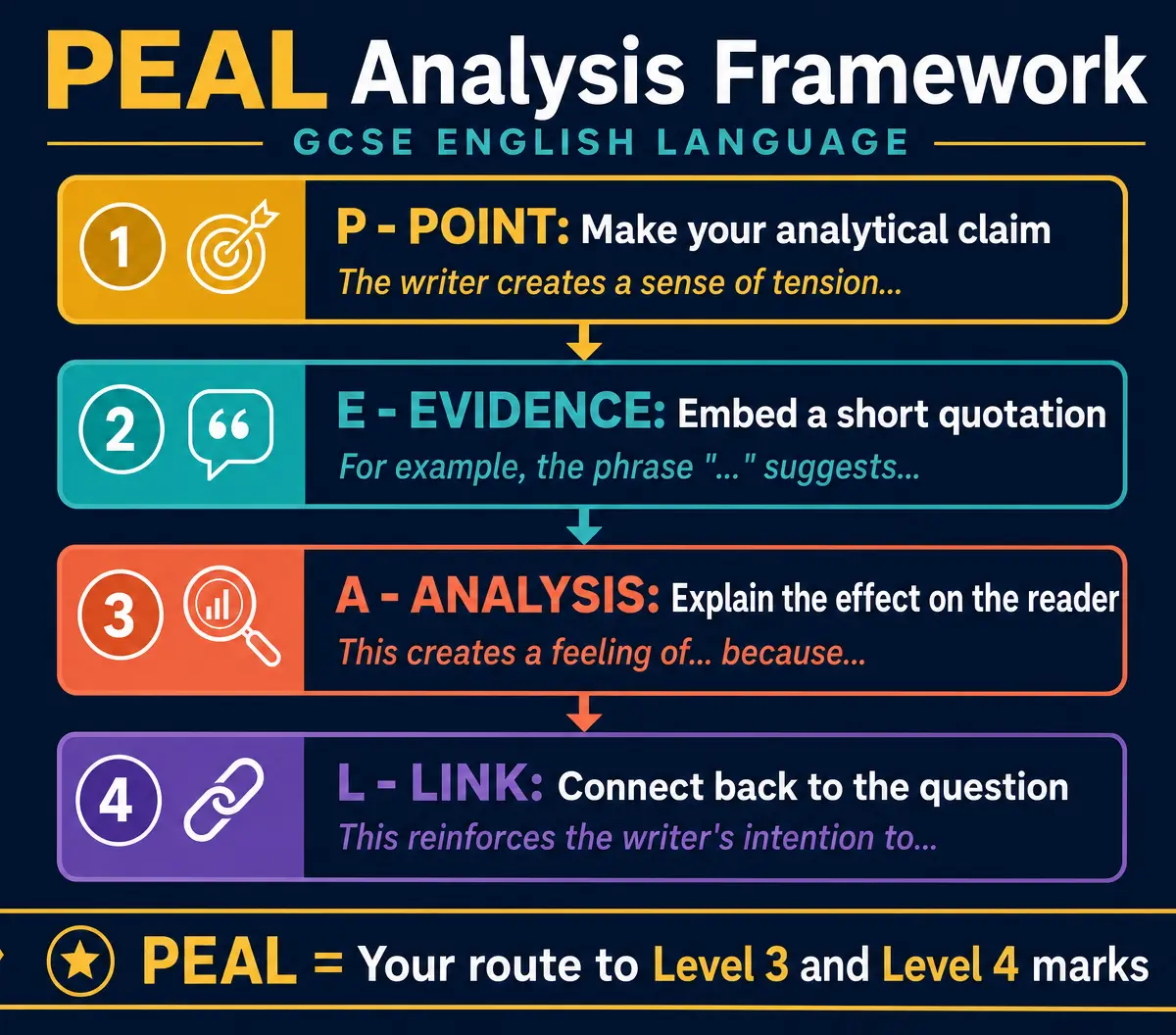
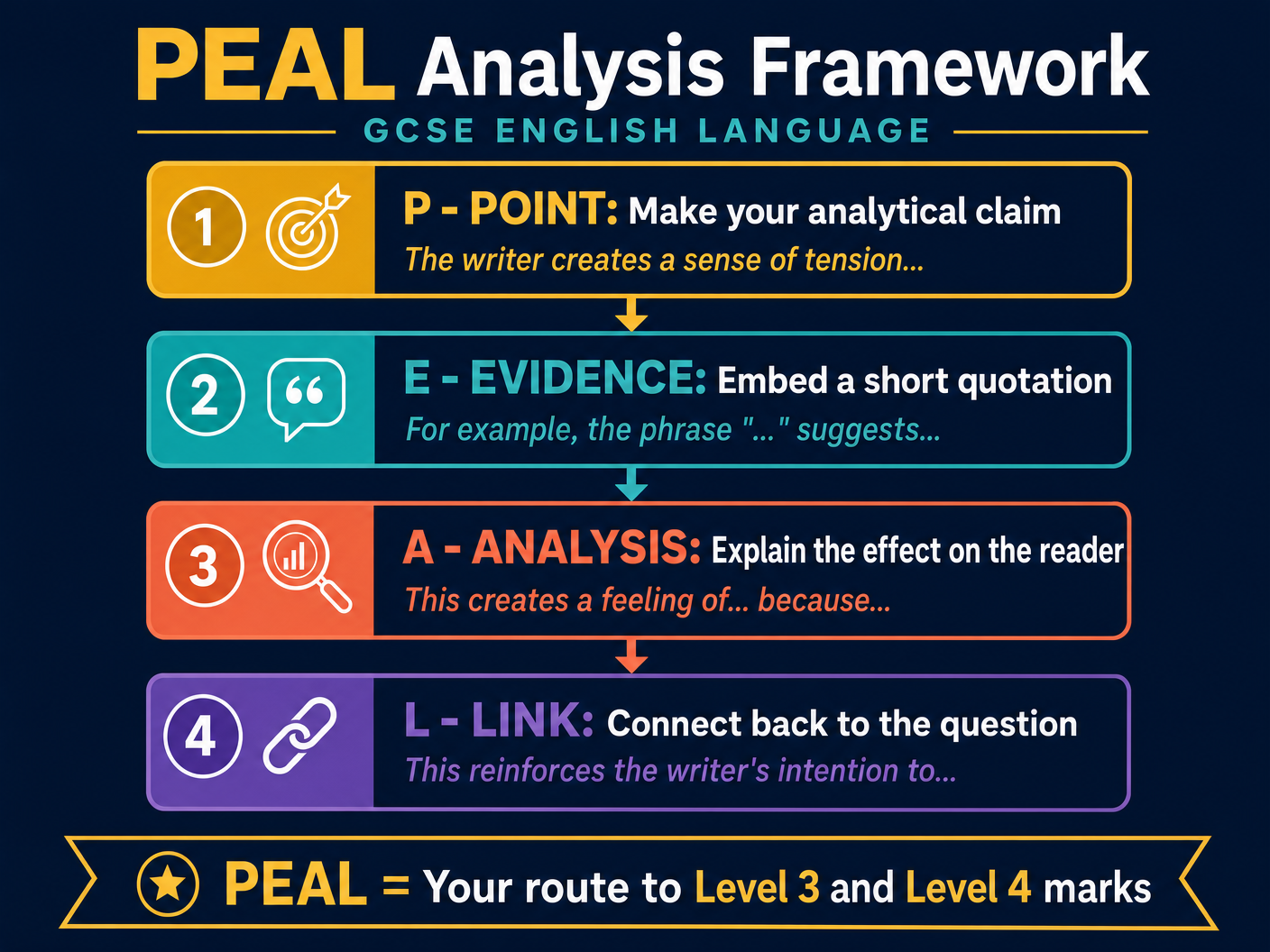
Language analysis is the core skill of English Language. You must move beyond simply identifying features (feature-spotting) and focus on explaining the effect of the language on the reader. Use the PEAL framework to structure your responses:
Key Language Features to Identify
| Feature | Definition | Effect on Reader | Example |
|---|---|---|---|
| Metaphor | A direct comparison stating one thing is another | Creates vivid imagery and transfers the qualities of the object to the subject | "The city was a sleeping beast." |
| Simile | A comparison using 'like' or 'as' | Makes descriptions more relatable and visual | "Her hands were as cold as ice." |
| Personification | Giving human qualities to non-human things | Brings the inanimate world to life, often creating atmosphere or tension | "The wind whispered through the trees." |
| Pathetic Fallacy | Weather or environment reflecting human emotion | Establishes mood and foreshadows events | "Thunder crashed as the argument began." |
| Alliteration | Repetition of consonant sounds at the start of words | Draws attention to the phrase and can create a specific rhythm or tone | "The dark, damp, desolate street." |
| Sibilance | Repetition of 's' sounds | Can create a soft, soothing effect or a sinister, hissing tone | "The snake slithered silently." |
| Juxtaposition | Placing contrasting ideas side by side | Highlights differences and creates tension or surprise | "The innocent child stood before the ruined castle." |
Analysing Structure (AO2)
Structure refers to how the text is put together and organised. Examiners reward candidates who can explain why the writer chose to order the text in a specific way.
- Openings: Does the text start in medias res (in the middle of the action)? Does it establish setting or introduce character first?
- Shifts in Focus: Where does the writer move our attention? (e.g., from the weather to a character's internal thoughts). Why does this shift happen?
- Sentence Length: Short, fragmented sentences build tension and pace. Long, complex sentences can build detailed imagery or suggest overwhelming emotion.
- Paragraph Structure: A single-sentence paragraph stands out and demands the reader's attention, often used for dramatic effect or revelation.
- Narrative Perspective: First-person ("I") creates intimacy. Third-person limited stays close to one character, while third-person omniscient provides a wider view.
- Cyclical Structure: Does the ending echo the beginning? This can suggest a lack of progress or a sense of inevitability.
Evaluating Critically (AO4)
Evaluation questions ask you to form a judgement about the text and support it with evidence. You might be given a statement (e.g., "A student said: 'The writer makes the character seem completely isolated.' To what extent do you agree?"). You must confidently express your opinion, select relevant evidence, and analyse the methods the writer uses to create that impression.
Writing Skills (Section B)
Section B tests your ability to communicate clearly and imaginatively (AO5) and your technical accuracy (AO6). You will typically be given a choice of titles or prompts for a piece of creative prose writing (e.g., a narrative or a description).
Creative Writing Techniques
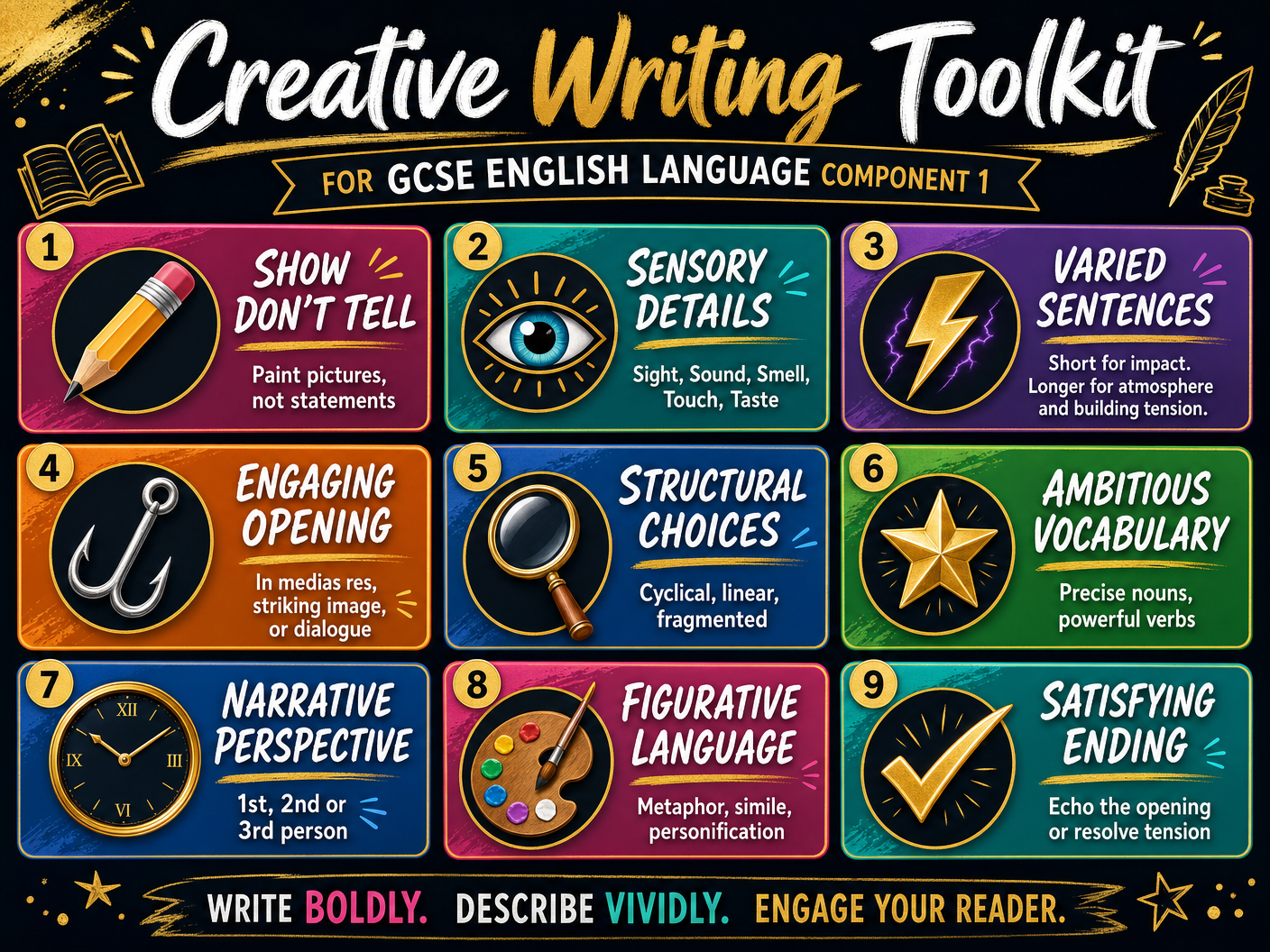
To achieve the highest marks, your writing must be crafted deliberately. You are not just telling a story; you are demonstrating your control of language and structure.
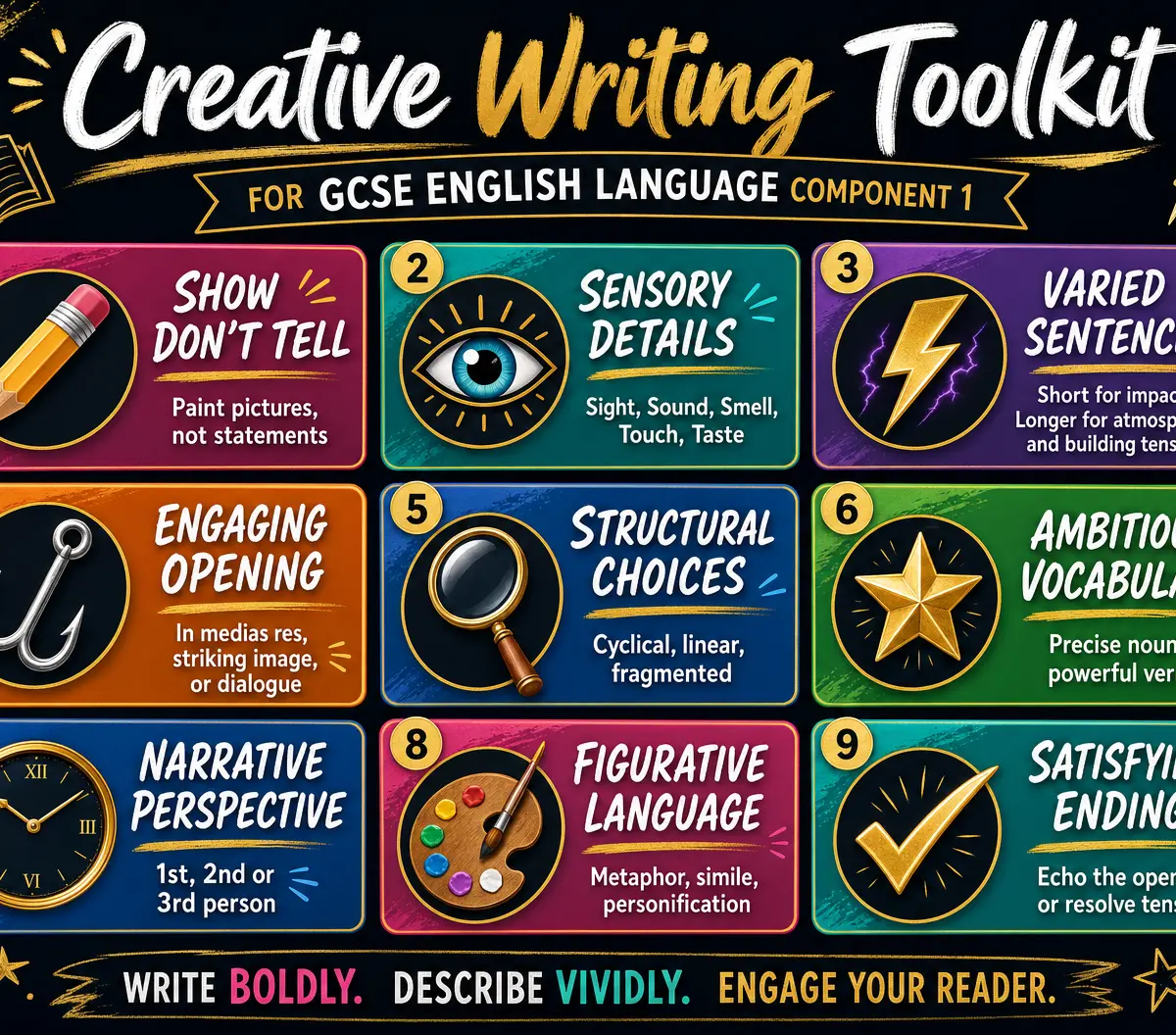
- Show, Don't Tell: Instead of stating an emotion ("He was terrified"), describe the physical symptoms ("His hands trembled as he reached for the door handle").
- Sensory Description: Engage the reader by describing sight, sound, smell, touch, and taste. This creates a more immersive experience.
- Varied Sentence Structures: Consciously mix short sentences for impact with longer sentences for detail and flow.
- Engaging Openings: Hook the reader immediately. Avoid long, slow introductions. Start with action, dialogue, or a striking image.
- Satisfying Endings: Your ending should feel planned. Consider echoing your opening or leaving the reader with a powerful final image.
- The One-Scene Rule: For a 45-minute exam, keep your scope narrow. Focus on one specific moment, setting, or interaction in detail, rather than trying to write an epic saga spanning years.
Technical Accuracy (SPaG - AO6)
Your spelling, punctuation, and grammar account for a significant portion of the marks in Section B. You must demonstrate control and ambition.
- Ambitious Punctuation: Use a range of punctuation correctly. Semicolons (;) link closely related independent clauses. Colons (:) introduce lists or explanations. Dashes (—) create dramatic pauses or parenthetical asides.
- Paragraph Cohesion: Ensure your paragraphs link logically. Use discourse markers to guide the reader through your narrative or description.
- Vocabulary: Select precise, powerful verbs and specific nouns rather than relying heavily on adjectives and adverbs.
Visual Resources
3 diagrams and illustrations
Interactive Diagrams
2 interactive diagrams to visualise key concepts
Conceptual Flow Outline
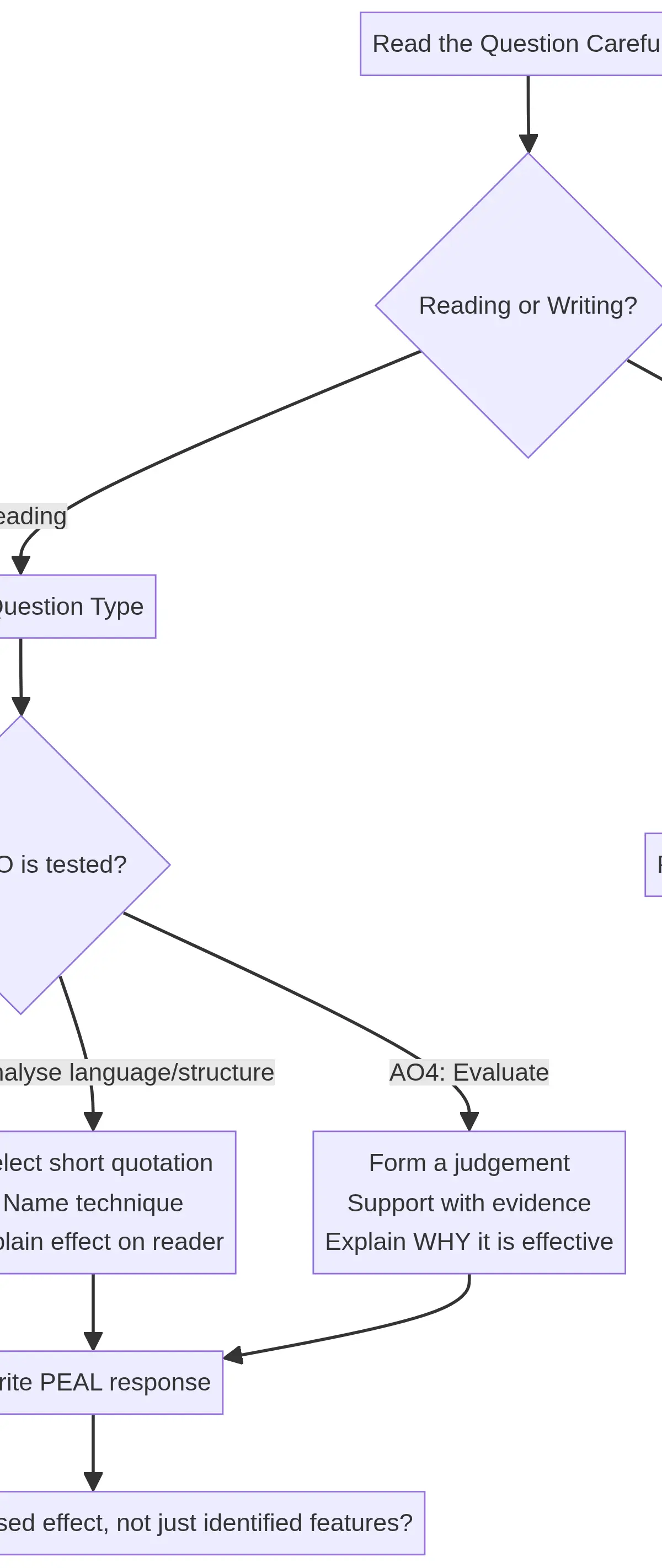
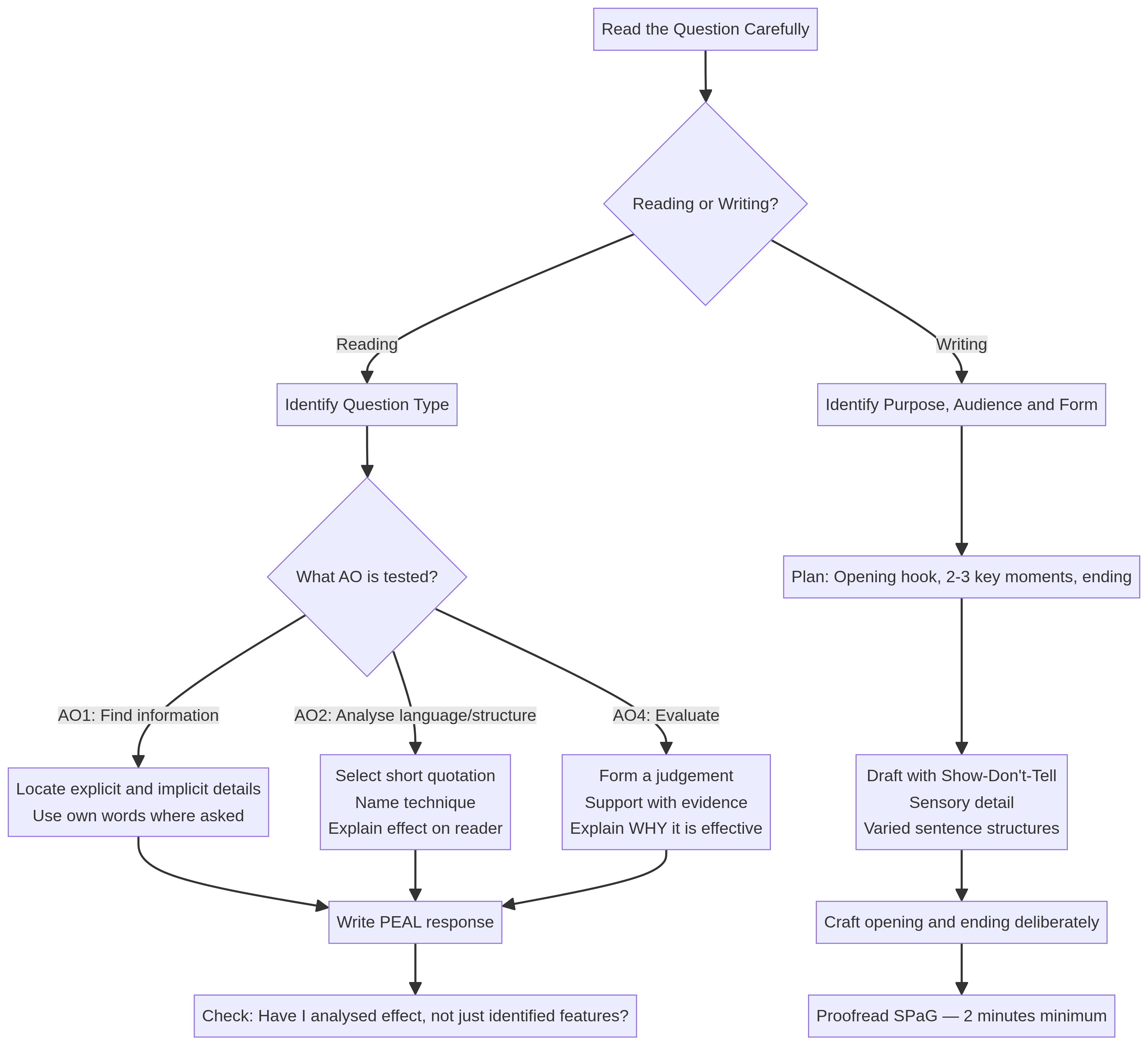
Component 1 Exam Approach Flowchart
Conceptual Flow Outline
Levels of Response Marking Framework
Worked Examples
3 worked examples — open one to explore the question and available guidance.
Practice Questions
Test your understanding — click to reveal model answers
List four things you learn about the setting from lines 1-5.
Hint: Only look at lines 1-5. Keep your answers brief. You do not need to analyse.
How does the writer use language in lines 10-18 to describe the character's anger?
Hint: Look for powerful verbs, adjectives, or similes. Use PEAL to structure your answer.
A student said: 'The ending of this extract leaves the reader feeling completely hopeless.' To what extent do you agree?
Hint: Form a clear judgement. Find evidence that supports 'hopelessness' and analyse the writer's methods.
Write a narrative about a time you felt completely lost. (24 marks)
Hint: Plan your structure. Use 'show, don't tell' to describe the feeling of being lost. Focus on sensory details.
Write a description of an abandoned building. (24 marks)
Hint: Focus purely on description, not narrative. Use all five senses. Organise your paragraphs logically (e.g., outside to inside).